Why blank accuracy becomes a forming cost
A paper cup blanking machine prepares the fan-shaped sidewall pieces that later become paper cups. When those blanks vary in shape, size, print position, edge condition, or batch identity, the problem may appear much later as unstable feeding, poor overlap, irregular cup height, sealing difficulty, or extra rejects at the paper cup forming machine.
This delay makes the loss easy to misdiagnose. Operators may adjust forming settings repeatedly even though the variation started upstream. At the same time, not every forming defect comes from the blank. Mold condition, bottom paper, heat, pressure, ultrasonic or hot-air settings, and operator handling can produce similar symptoms.
Quick answer: manage paper cup fan cutting accuracy with an approved drawing, a known-good reference blank, lot identification, incoming checks, and a defect-trace method. The goal is not to blame the cutting stage; it is to separate blank-related variation from forming-related variation before waste spreads across a full order.
What a paper cup blanking machine controls
Blanking converts suitable coated and, when required, printed paper into repeated fan shapes. The machine and tooling must produce blanks that match the approved cup design, forming mold, side-seam overlap, paper characteristics, and artwork layout. Production speed matters only after this repeatability is demonstrated.
A paper cup fan cutting machine does not determine finished-cup quality by itself. It creates one controlled input for the next process. The forming stage still has to feed the fan, wrap it around the mold, join the side seam, combine it with bottom paper, form the rim, and complete inspection.
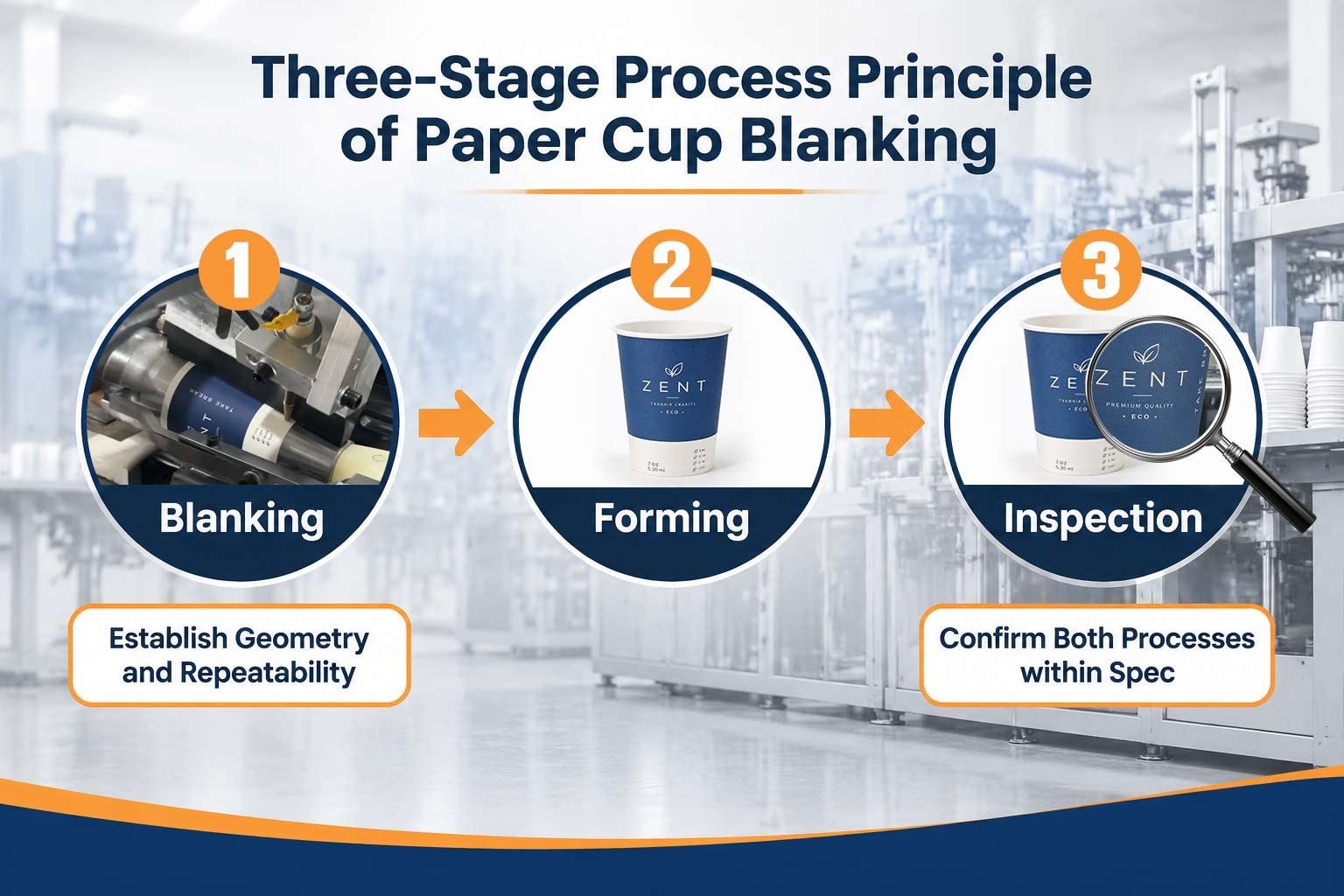
Process principle: blanking establishes geometry and repeatability; forming converts that geometry into a cup; inspection confirms whether both processes stayed within the approved product definition.
Buyers comparing a paper cup die cutting machine should therefore request trials with their intended fan drawings, paper, print layouts, and forming samples rather than accepting a demonstration based only on a convenient generic blank.
Which blank features affect forming
The fan is a curved production component, not simply a printed piece of paper. Several features work together. A change that looks small on a flat blank can change how the sidewall wraps, overlaps, aligns with the bottom, or reaches the required finished height.
| Blank feature | What it supports | What to control |
|---|
| Side edges and overlap width | Consistent side-seam joining and cup circumference | Approved dimensions, clean edges, and repeatable orientation |
| Upper and lower curved edges | Cup height, rim position, and relationship to the bottom area | Shape consistency against the approved drawing or template |
| Artwork position | Brand appearance after wrapping and seam formation | Print-to-cut registration and protected seam zones |
| Edge and coating condition | Stable feeding, joining, and clean finished appearance | Burrs, torn fibers, coating damage, dust, and deformation |
The approved blank specification must come from the cup design and forming requirements. A factory should not copy dimensions from a different mold, cup size, or supplier merely because the blanks look similar when stacked.

A symptom-to-source diagnostic map
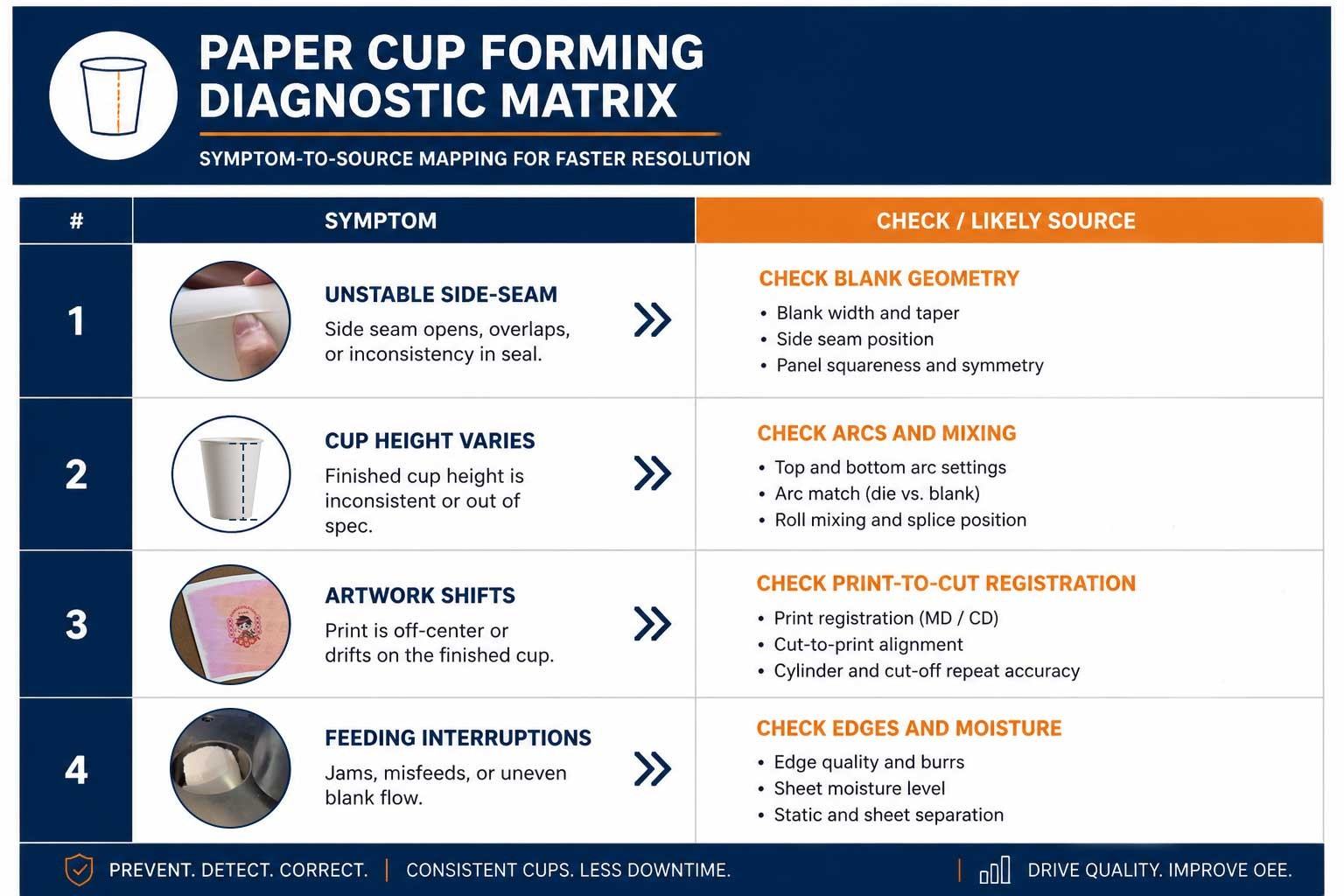
A symptom map helps the team decide what to check first without declaring a root cause too early. Each symptom below can have more than one source; the blank-related checks are screening steps, not final conclusions.
| Forming symptom | Possible blank-related check | Other process checks |
|---|
| Unstable side-seam overlap | Compare side-edge position and overall fan geometry with a known-good blank | Feeding position, guides, mold alignment, and joining settings |
| Cup height varies within one batch | Check upper and lower arcs, blank mixing, and deformation during storage | Mold condition, rim forming, bottom position, and handling |
| Artwork shifts toward the seam | Verify print-to-cut registration and fan orientation | Feeding rotation and approved artwork layout |
| Feeding interruptions increase after a new lot | Inspect edges, curl, moisture condition, dust, and blank separation | Feeder cleanliness, static, guides, and machine setup |
Diagnostic rule: compare the suspect lot with a retained known-good lot on the same controlled forming setup. If the symptom follows the blank lot, upstream investigation becomes stronger. If it remains with both lots, the forming process requires attention.
How to inspect incoming paper cup fans
Incoming inspection should be fast enough for daily use and specific enough to identify a changing lot. The factory can define its own sample size and acceptance rules based on order risk, supplier history, cup application, and internal quality requirements.
- Verify identity. Match cup size, artwork, paper, coating, supplier lot, production date, and quantity with the purchase and work order.
- Check the stack. Look for mixed blanks, curl, compression damage, moisture exposure, dust, and inconsistent orientation.
- Compare geometry. Use the approved drawing, checking fixture, or master sample to review critical edges and overall shape.
- Review print-to-cut position. Confirm that artwork and seam-safe areas match the approved finished-cup appearance.
- Inspect edge condition. Record torn fibers, burrs, coating damage, crushing, or other features that may affect feeding and joining.
- Run a controlled forming sample. Approve the lot only after representative blanks pass the relevant cup-forming and appearance checks.
Keep the accepted sample and inspection record linked to the lot. If a problem appears during production, the team can compare current blanks with the original release evidence rather than relying on memory.
A low fan purchase price is not useful if variation creates extra forming loss. Calculate the cost from usable output, not only purchased quantity.
Usable blank rate = blanks accepted for production ÷ blanks inspected or processed
Effective blank cost per usable piece = total lot purchase and handling cost ÷ usable blanks from the lot
For a broader loss view, add forming labor, machine time, bottom paper, inspection, disposal, and delayed-order cost associated with blanks that fail after processing begins. Keep blank-caused rejects separate from rejects caused by forming setup or other materials; otherwise the supplier comparison will be misleading.
Track the result by SKU and lot across repeat orders. A single good trial cannot prove long-term consistency, while a trend of stable usable-cup yield provides stronger evidence for purchasing, supplier review, and production scheduling decisions.
Cost rule: compare suppliers or in-house blanking lots using usable cups produced from a controlled input quantity. Purchased blank price alone cannot reveal the economic effect of geometry variation.
Common sources of blanking variation
Variation can come from the paper, tooling, process setup, handling, or document control. A practical investigation reviews the complete route instead of adjusting only the cutting pressure.
- Tooling wear, damage, looseness, or an unapproved die revision.
- Paper movement, curl, inconsistent feeding, or changing moisture condition.
- Print-to-cut registration drift or artwork prepared for a different blank version.
- Mixed cup sizes, designs, suppliers, or production lots in one stack.
- Edge crushing or deformation during stacking, transport, or storage.
- Inspection fixtures, master samples, or drawings that do not share the same revision.
Tooling maintenance records and first-piece approvals make these causes easier to separate. Without them, each new shift may create a different setup while everyone believes they are producing the same paper cup fan.
A controlled troubleshooting workflow
When forming waste rises, random machine adjustments can hide the original cause. Use a controlled comparison that changes one input at a time.
- Hold the suspect fan lot and record the forming machine, mold, settings, bottom paper, time, operator, and observed symptom.
- Collect rejected cups and their source blanks when possible; do not discard the evidence immediately.
- Compare suspect blanks with the approved drawing, fixture, and retained known-good samples.
- Run known-good blanks on the same forming setup without changing unrelated settings.
- If the symptom follows the suspect lot, investigate paper, print registration, tooling, and blanking records.
- If the symptom remains with known-good blanks, inspect the forming machine, mold, bottom paper, joining process, and handling conditions.
- Confirm the corrective action with a controlled production batch and monitor the next repeat order.
This workflow protects production time because it prevents the cutting team and forming team from changing several variables at once. It also creates evidence for a supplier claim or internal corrective action when the root cause is confirmed.
Supplier and in-house traceability rules
Ready-cut fan suppliers and in-house paper fan die cutting machine operations need the same basic discipline: one approved revision, one identifiable lot, and one change record. The difference is who owns the process evidence.
- Assign a unique specification code to every cup size and approved blank revision.
- Link paper, coating, artwork, printing, tooling, operator, inspection, and date to each lot.
- Require approval before changing the die, drawing, print position, paper grade, or supplier source.
- Keep a retained known-good blank and finished cup for important repeat SKUs.
- Separate rejected, suspect, released, and reworked blanks physically and in records.
- Review usable-cup yield by lot, not only total daily output.
These rules reduce argument between departments and suppliers. More importantly, they shorten the time between a forming symptom and a controlled decision to release, rework, return, or reject the fan lot.
Frequently asked questions
Is a paper cup blanking machine the same as a printing machine?
No. Printing applies the artwork, while blanking cuts the controlled fan shape. A production route may print first and cut afterward, but each process has separate settings and quality checks.
Can one fan shape work on different cup molds?
Do not assume so. The blank must match the approved cup geometry, mold, overlap, paper, and forming process. Similar-looking cup sizes may still require different fan specifications.
How can a factory confirm that a defect comes from the blank?
Compare the suspect lot with retained known-good blanks on the same controlled forming setup. Review geometry and records, then change only one variable at a time. A confirmed root cause needs repeatable evidence.
Should every incoming fan be measured?
The factory should define a risk-based sampling and release plan rather than assume one rule fits every order. New suppliers, changed specifications, critical printed orders, and poor-performing lots may justify stronger checks.
What information should be provided for a blanking-machine proposal?
Provide approved fan drawings or samples, paper and coating information, cup-size range, print layouts, expected order mix, required output, and forming-machine details. This supports a compatibility trial instead of a price-only comparison.
The Bottom Line
A paper cup blanking machine supports profitable production when it delivers identifiable, repeatable fans that match the approved forming process. The business value appears as fewer unexplained rejects, faster root-cause decisions, more stable repeat orders, and a more accurate cost per usable cup.
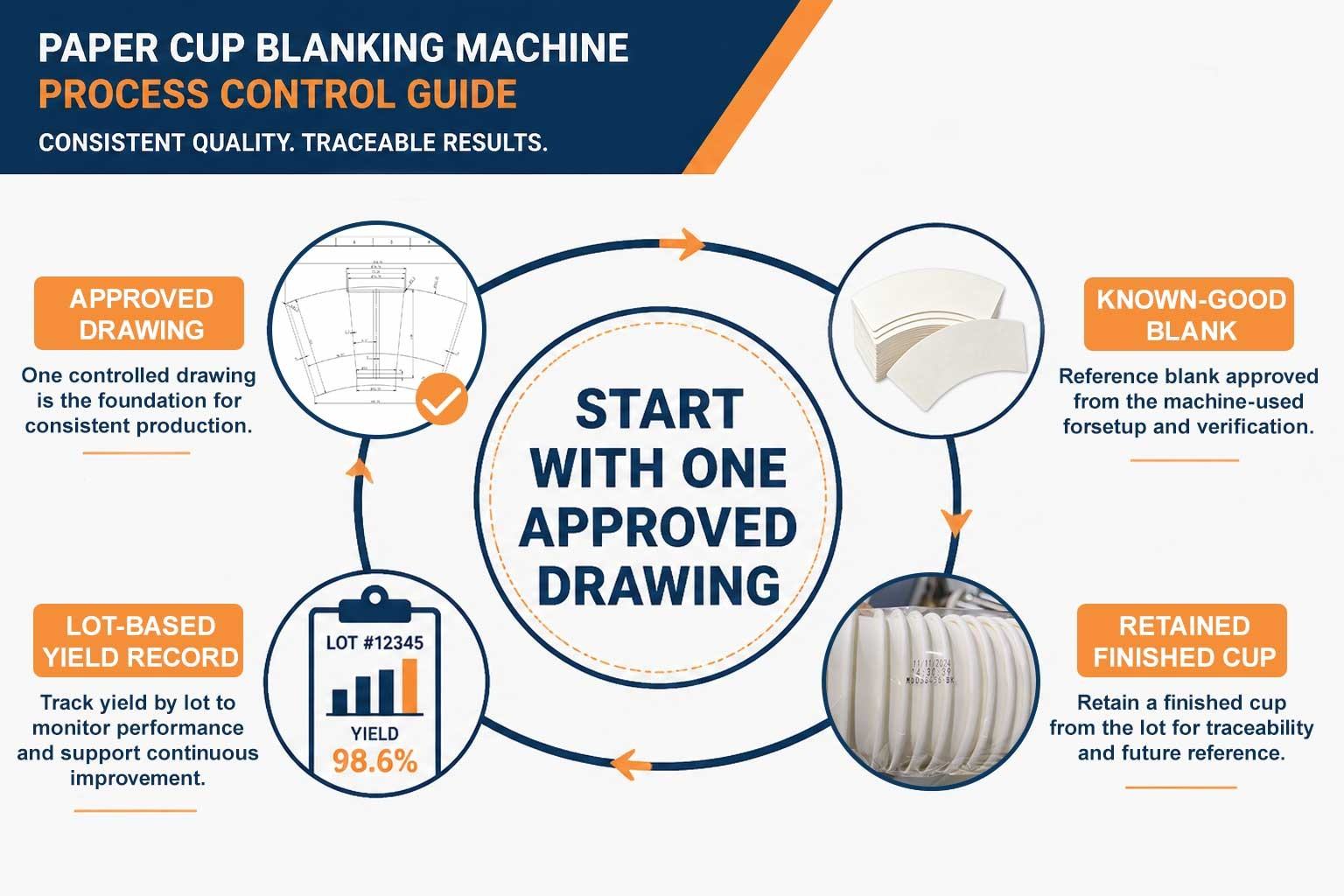
Start with one approved drawing, one known-good blank, one retained finished cup, and one lot-based yield record. Use those references to separate upstream blank variation from forming problems. When requesting equipment or supplier support, provide the actual cup, paper, artwork, fan, mold, and order information so the full process can be evaluated together.





 Tel: +86-13362708280
 Email: george@paper-cupmakingmachine.com
 MP/WhatsApp: +86-13362708280
 Manufacturer Address:No.1588, Huaming Road, Feiyun Street,Ruian City Zhejiang Province -325200 China