What Should Buyers Prepare Before the First Order?
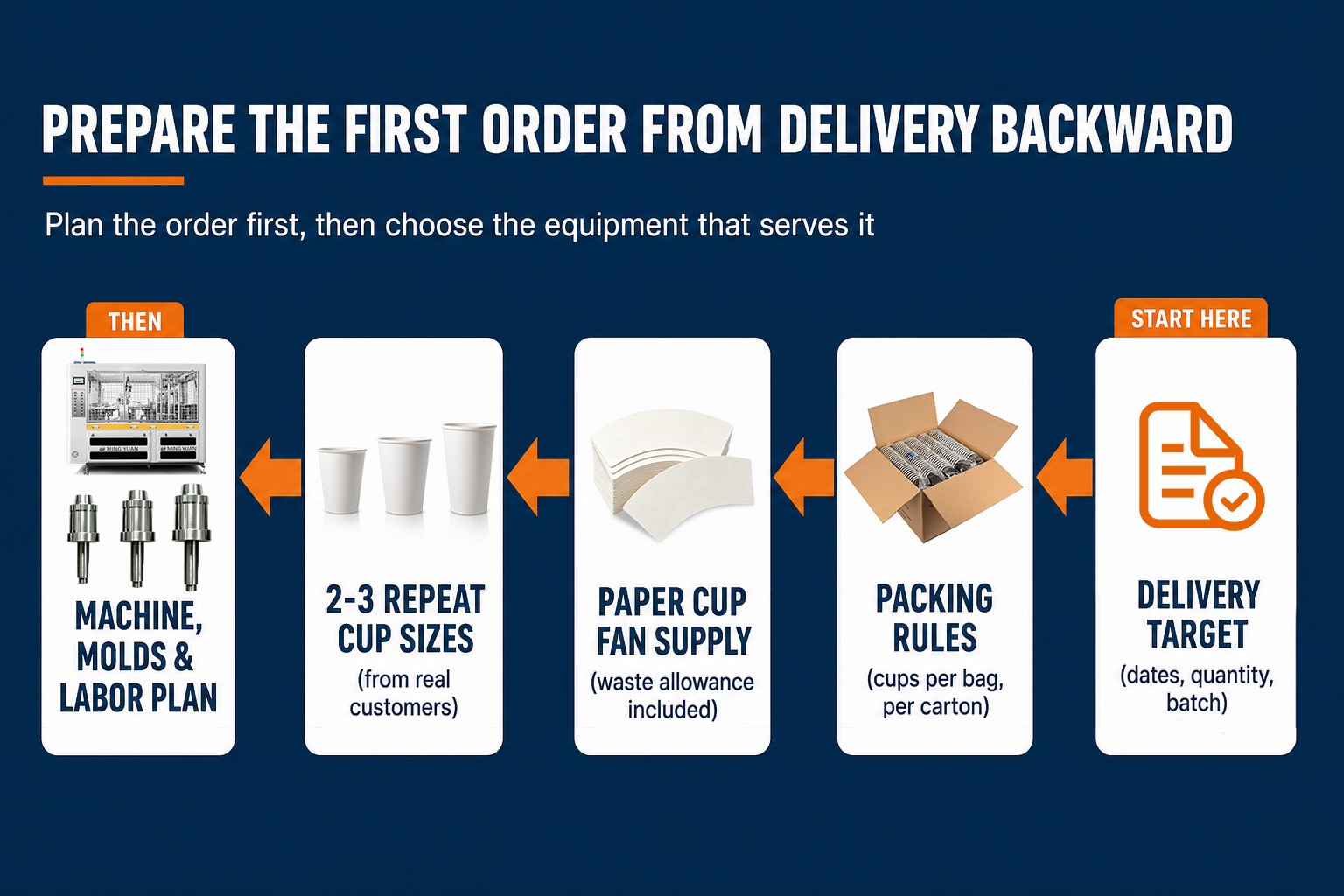
A disposable paper cup making machine should be planned around the first real order, not around the largest possible catalog of cup sizes. Before buying equipment, the buyer should confirm the first customer group, two or three repeat cup sizes, paper cup fan supply, packing rules, workshop layout, and a realistic delivery target.
This matters because the first order exposes the weak points of a new factory. If the cup size is wrong, molds may sit idle. If the fan stock is too small, production stops. If packing is not planned, formed cups wait in the workshop instead of becoming sellable cartons.
For buyers comparing a paper cup machine, the most practical rule is: prepare the first order backward from delivery, then choose the machine, molds, fan stock, labor, and packing method around that order.
What Does the First Order Really Decide?
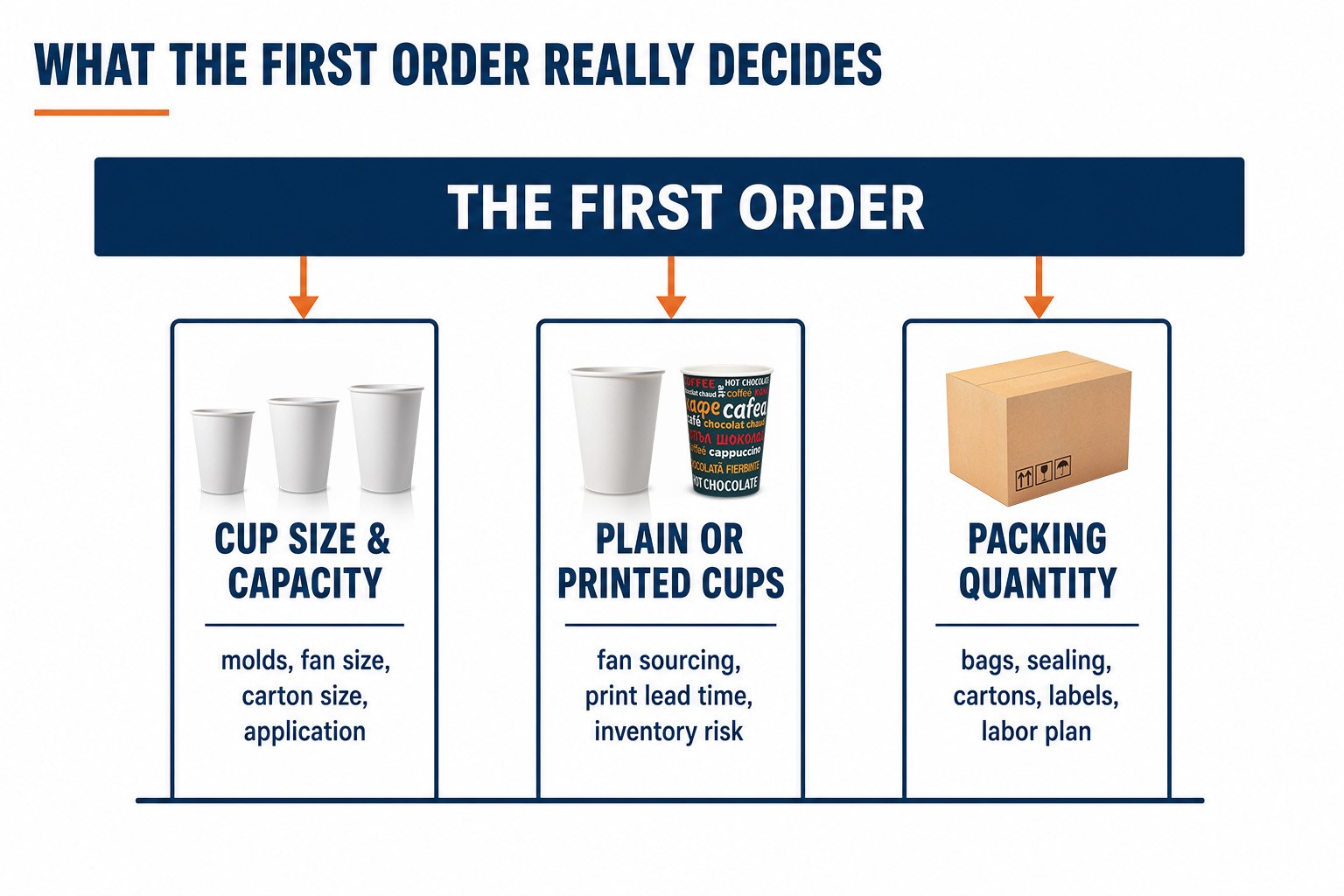
The first order is more than a sales target. It decides the first mold list, the first material purchase, the first operator training plan, the first packing standard, and the first delivery promise. A startup factory that treats the first order as a production test can avoid many expensive early mistakes.
| First-Order Decision | What It Controls | Buyer Benefit |
|---|
| Cup size and capacity | Molds, fan size, carton size, and customer application | Avoids buying molds for slow-moving cups |
| Plain or printed cups | Fan sourcing, print lead time, and inventory risk | Keeps startup material planning simple |
| Packing quantity | Bags, sealing, cartons, labels, and labor plan | Turns formed cups into customer-ready stock |
How Should Buyers Choose First Cup Sizes?
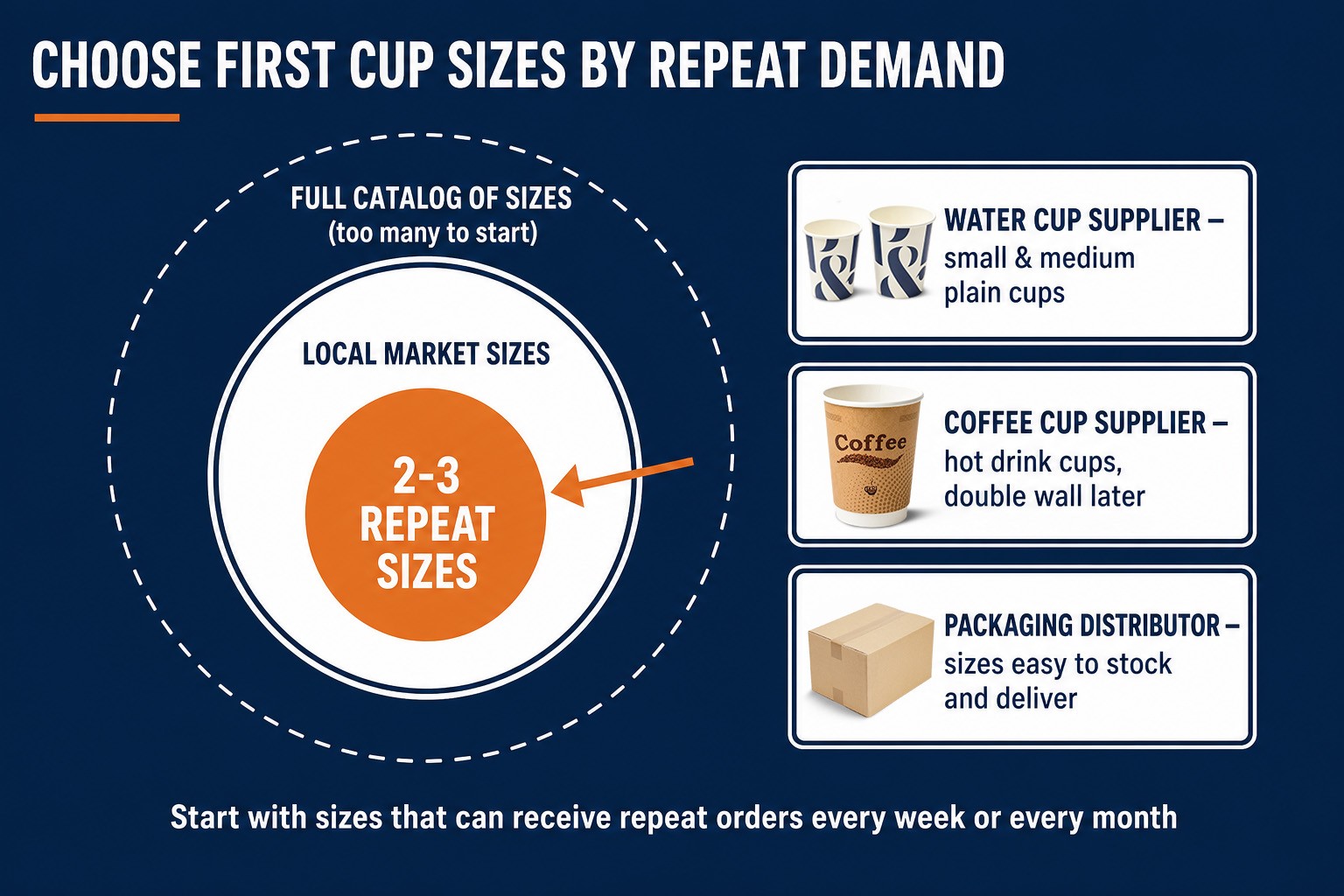
New buyers often want to produce many disposable cup sizes immediately. In practice, a narrower first product mix is usually easier to sell, train, inspect, and pack. For a new disposable cup making machine project, the first cup sizes should come from repeat demand in the local market.
A water cup supplier may start with small and medium plain cups. A coffee cup supplier may need hot drink cups and possibly double wall cups later. A packaging distributor may choose sizes that are easy to stock and deliver quickly to restaurants, beverage shops, and event suppliers.
Cup size rule
Start with sizes that can receive repeat orders every week or every month. Add special sizes only after customers prove stable demand.
How Much Paper Cup Fan Stock Is Practical?
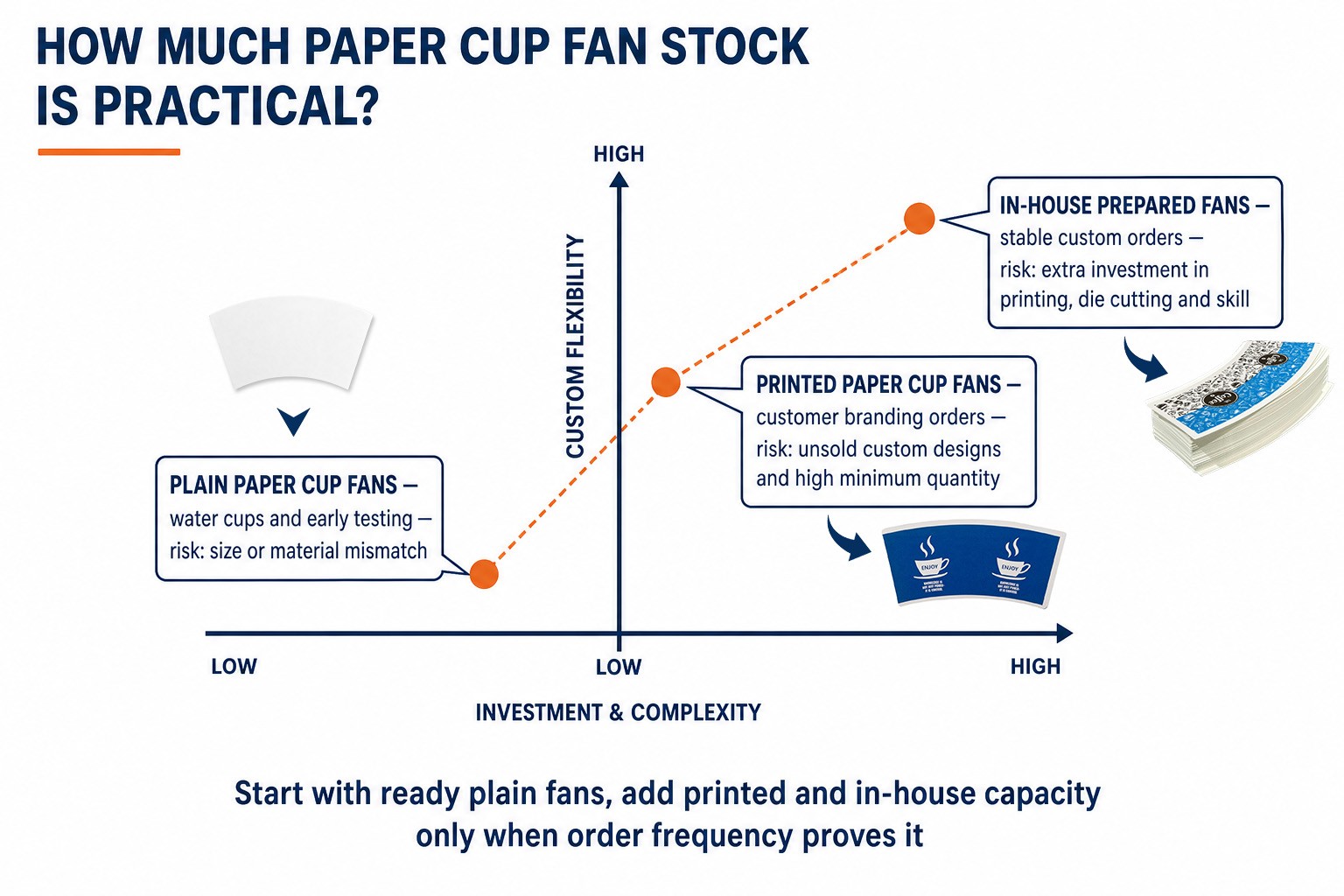
Paper cup fan stock is one of the easiest parts to underestimate. If the buyer orders only enough fans for the visible customer order, test waste, setup loss, rejected cups, and delivery changes may create a shortage. If the buyer orders too much printed fan stock, cash may be locked in designs that are difficult to reuse.
| Fan Stock Type | Practical Use | Risk to Control |
|---|
| Plain paper cup fans | Water cups, simple drink cups, early factory testing | Wrong size or material mismatch |
| Printed paper cup fans | Customer branding and promotional cup orders | Unsold custom designs and higher minimum quantity |
| In-house prepared fans | Factories with stable custom orders and printing control needs | Extra investment in printing, die cutting, skill, and waste control |
For the first stage, many buyers are safer with ready fans and a narrow size range. In-house printing and die cutting should be added when custom orders are frequent enough to justify the equipment, staff, and material control.
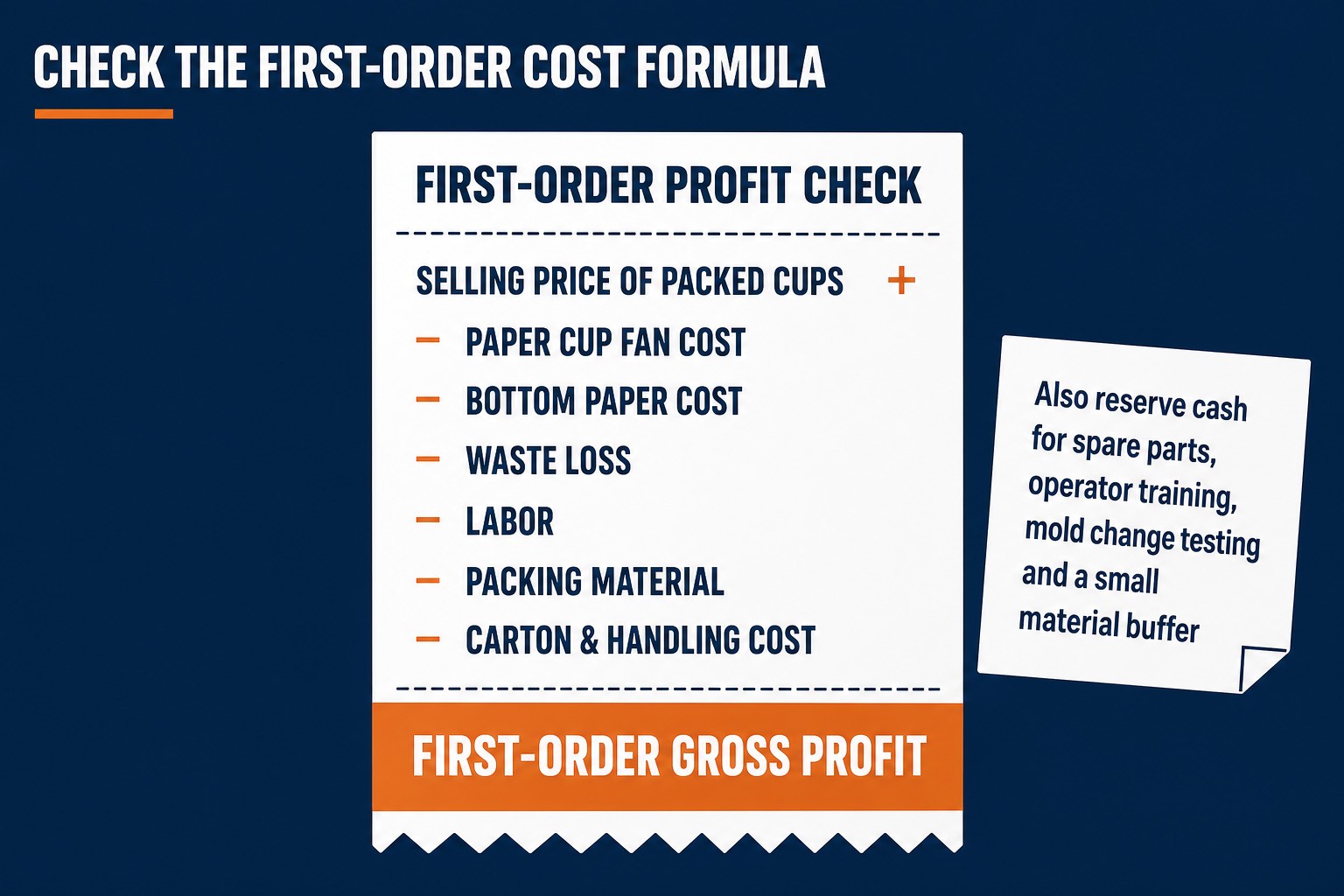
A disposable paper cup making machine can look profitable on paper if the buyer calculates only raw material and expected selling price. The real calculation should use accepted packed cups, because waste, stoppage, labor, packing, and cartons all affect usable profit.
First-order profit check
First-order gross profit = selling price of packed cups - paper cup fan cost - bottom paper cost - waste loss - labor - packing material - carton and handling cost.
The buyer should also reserve cash for first spare parts, operator learning time, mold change testing, and a small material buffer. If the first-order plan has no waste allowance, the actual profit is usually lower than expected. This check also makes supplier quotations easier to compare.
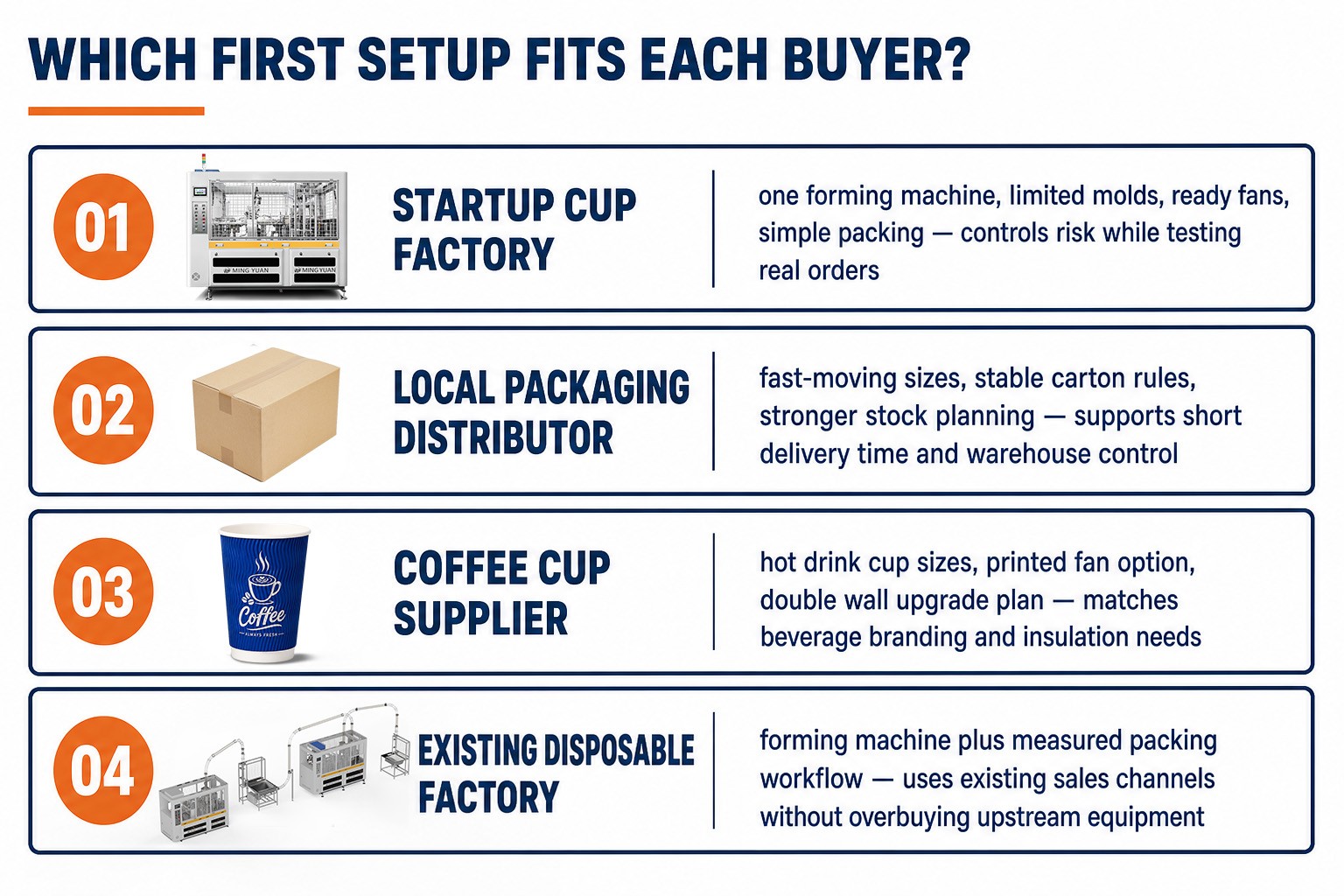
Which Setup Fits Different Buyers?
| Buyer Type | Recommended First Setup | Why It Fits |
|---|
| Startup cup factory | One forming machine, limited molds, ready fans, simple packing | Controls risk while testing real orders |
| Local packaging distributor | Fast-moving sizes, stable carton rules, stronger stock planning | Supports short delivery time and warehouse control |
| Coffee cup supplier | Hot drink cup sizes, printed fan option, double wall upgrade plan | Matches beverage branding and insulation needs |
| Existing disposable product factory | Disposable paper cup making machine plus measured packing workflow | Uses existing sales channels without overbuying upstream equipment |
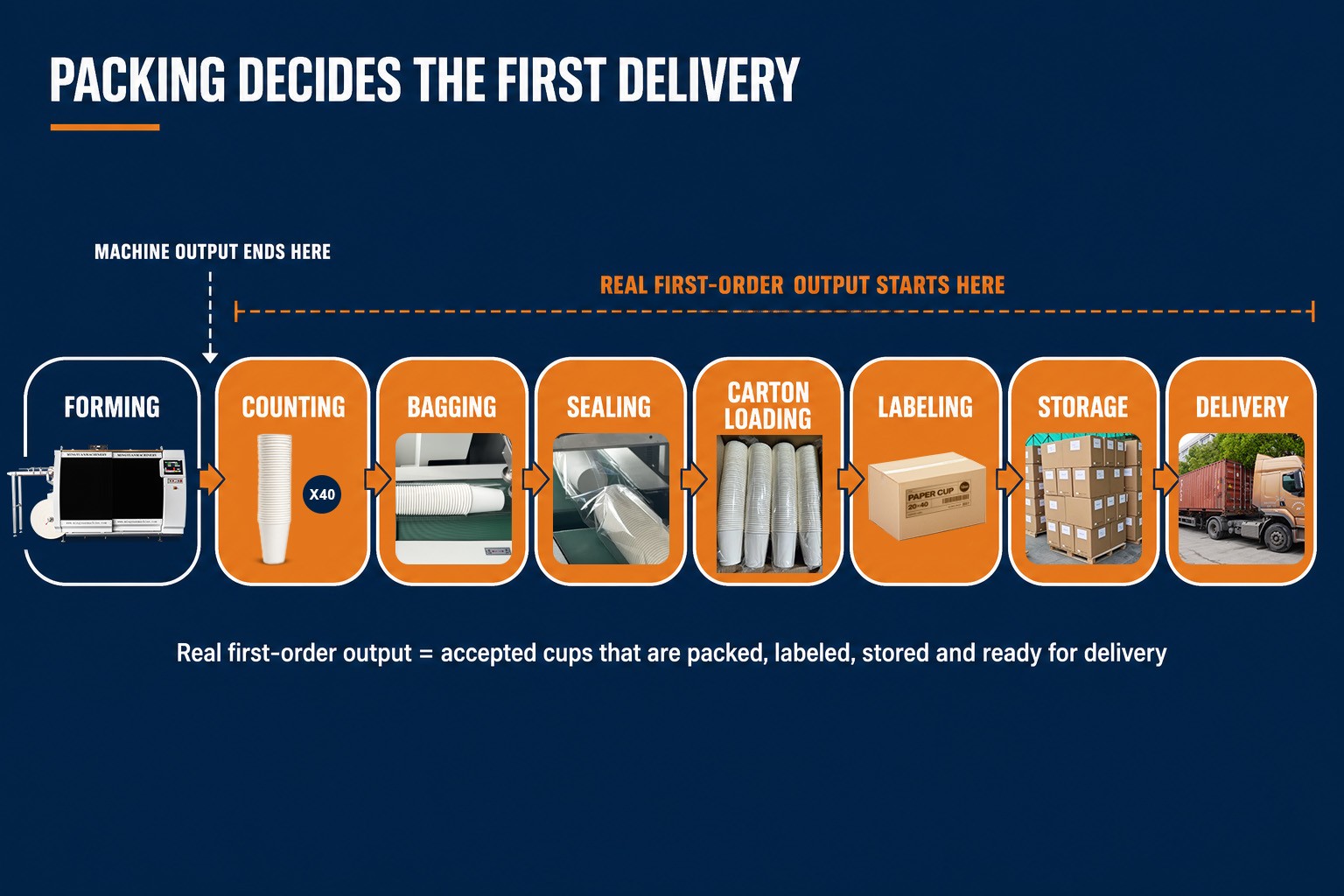
Why Packing Affects the First Delivery
Many first-order delays happen after cups are formed. The machine may produce cups, but the workshop still needs counting, bagging, sealing, carton loading, labeling, and storage. If these steps are manual and unplanned, delivery speed can be lower than forming speed.
For early production, the buyer should define cups per bag, bags per carton, carton size, label content, inspection rule, and finished goods area. A paper cup packing machine may not be necessary on the first day, but the packing method must be clear before production starts.
Delivery rule
Real first-order output = accepted cups that are packed, labeled, stored, and ready for customer pickup or delivery.
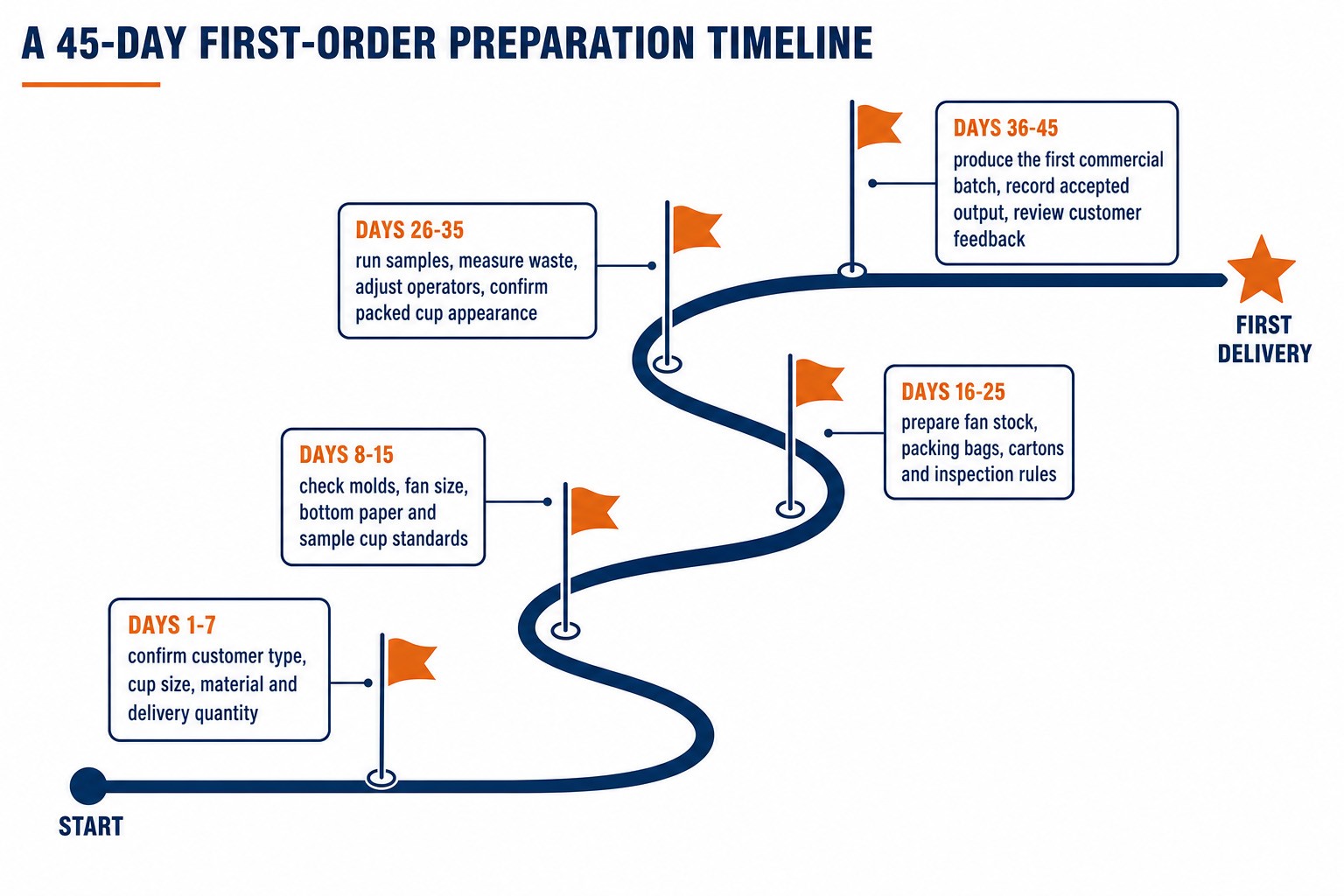
A 45-Day First-Order Preparation Timeline
- Days 1-7: confirm customer type, cup size, cup material, and delivery quantity.
- Days 8-15: check mold requirements, fan size, bottom paper, and sample cup standards.
- Days 16-25: prepare paper cup fan stock, packing bags, cartons, and inspection rules.
- Days 26-35: run samples, measure waste, adjust operators, and confirm packed cup appearance.
- Days 36-45: produce the first commercial batch, record accepted output, and review customer feedback.
When Should Buyers Upgrade After the First Order?
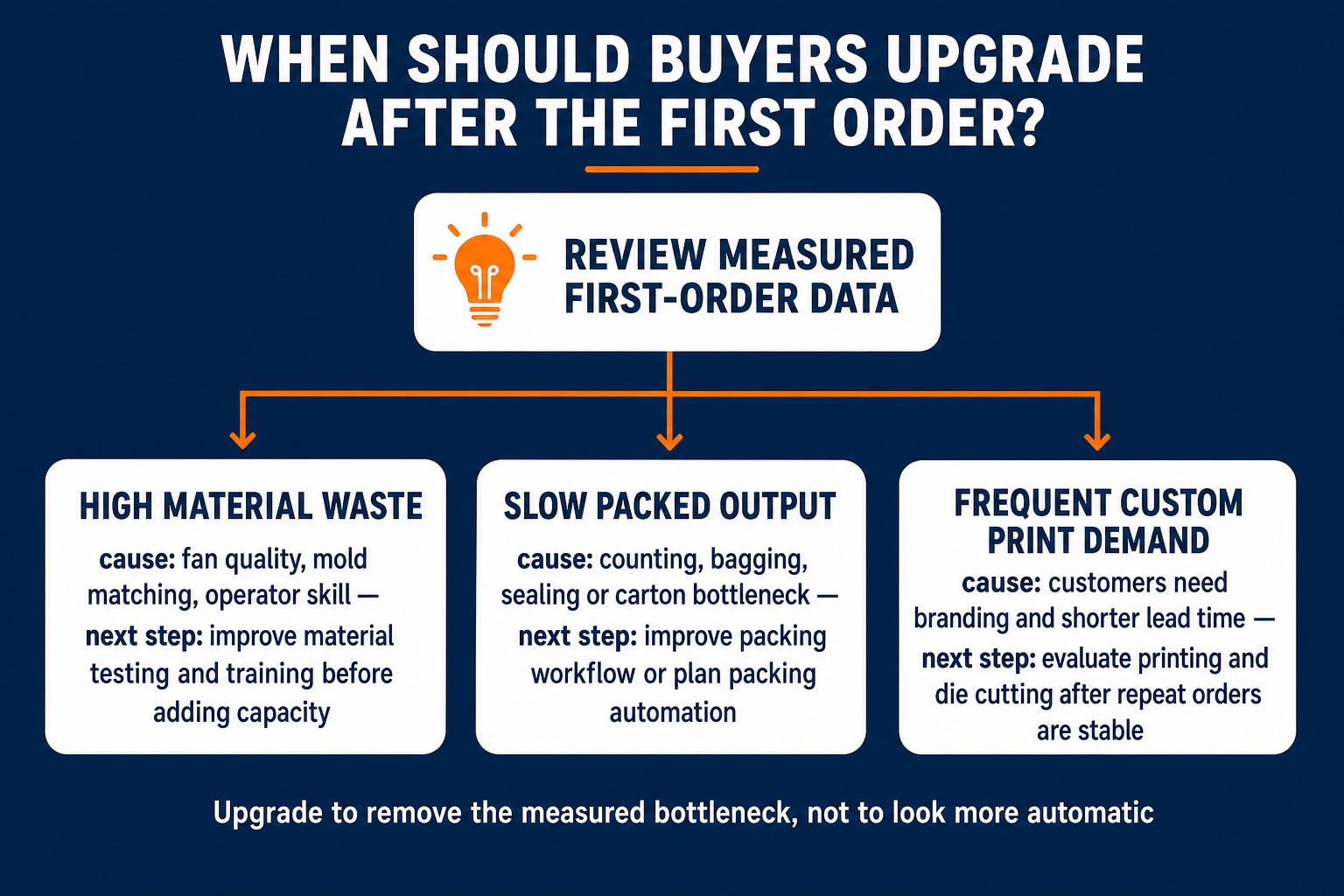
The first order should create production data, not just finished cartons. After delivery, the buyer should review where time, material, and labor were lost. This review shows whether the next investment should be another forming machine, better fan supply, in-house printing and die cutting, or downstream packing equipment.
| Measured Problem | Likely Cause | Practical Next Step |
|---|
| High material waste | Fan quality, mold matching, operator skill, or setup control | Improve material testing and training before adding capacity |
| Slow packed output | Counting, bagging, sealing, or carton preparation bottleneck | Improve packing workflow or plan packing automation |
| Frequent custom print demand | Customers need branding and shorter print lead time | Evaluate printing and die cutting after repeat orders are stable |
The best upgrade is the one that removes the measured bottleneck, not the one that simply looks more automatic. This keeps investment connected to profit and avoids buying equipment that the order base cannot support yet.
Common First-Order Mistakes
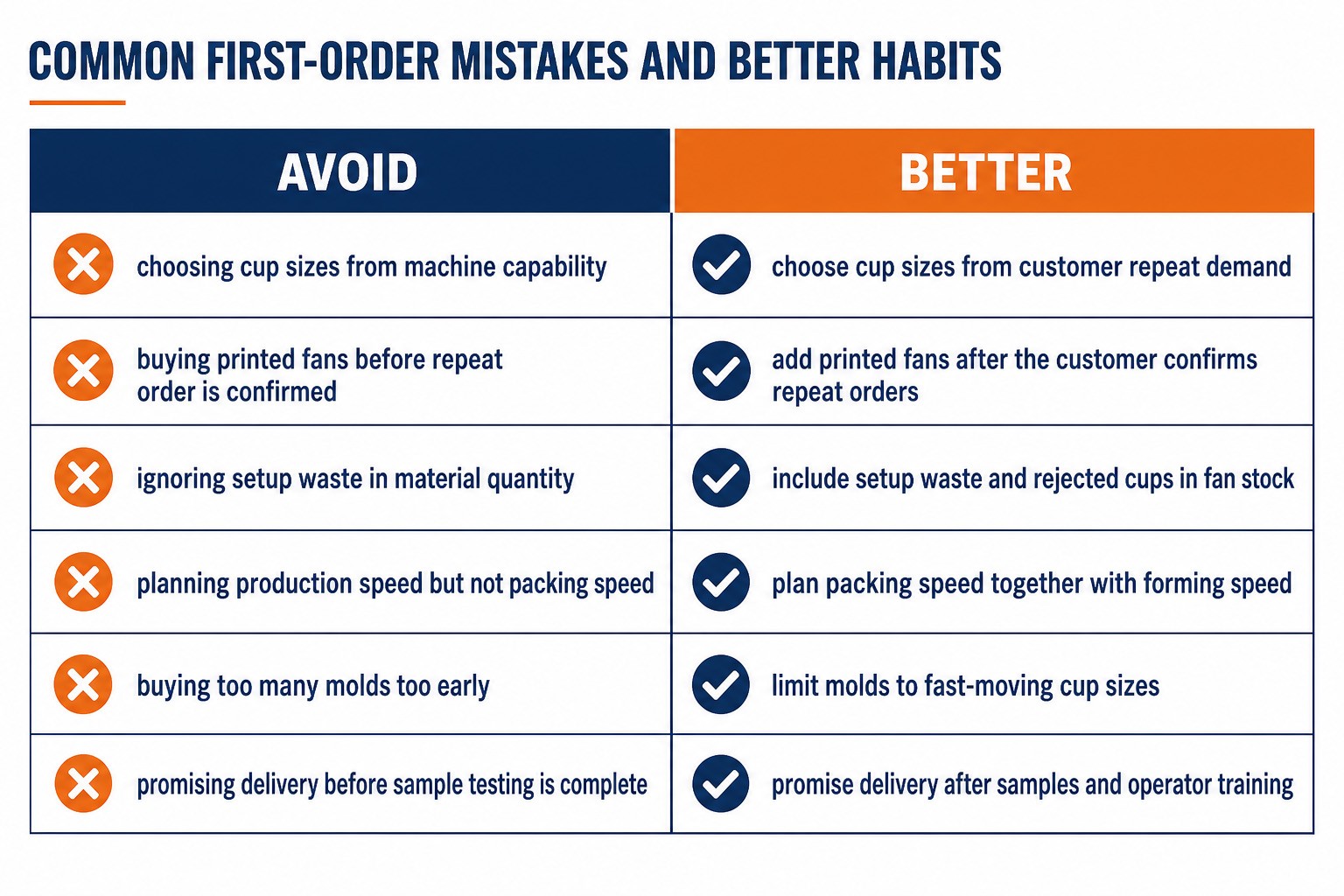
- Choosing cup sizes from machine capability instead of customer demand.
- Buying printed fans before the customer confirms repeat order stability.
- Ignoring setup waste when calculating first-order material quantity.
- Planning production speed but not planning packing speed.
- Buying too many molds before the factory understands local sales rhythm.
- Promising delivery dates before sample testing and operator training are complete.
Pre-Purchase Checklist
- List the first customer group and expected repeat order size.
- Confirm two or three cup sizes before ordering molds.
- Calculate paper cup fan stock with setup waste and rejected cups included.
- Prepare bottom paper, packing bags, cartons, labels, and storage space.
- Create a first-order cost sheet based on packed accepted cups.
- Decide when upstream printing, die cutting, or downstream packing automation will be added.
- Review the first delivery before expanding into more sizes or more equipment.
Frequently Asked Questions
What should I confirm before buying a disposable paper cup making machine?
Confirm the first cup sizes, customer group, paper cup fan supply, packing quantity, workshop space, operator plan, and first-order delivery target.
Should I start with plain cups or printed cups?
Plain cups are usually easier for startup testing and stock control. Printed cups are useful when a customer has confirmed branding requirements and repeat order potential.
How many molds should a new factory buy first?
A new factory should usually start with a limited mold list based on fast-moving cup sizes. More molds can be added after sales data proves demand.
Is a paper cup packing machine necessary at startup?
Not always. Manual packing can work for early orders, but packing rules must be planned from the beginning. If formed cups wait too long before bagging and cartoning, packing becomes the next bottleneck.
When should I add printing and die cutting equipment?
Add printing and die cutting when custom printed cup orders are stable enough to justify more equipment, staff training, waste control, and material inventory management.
The Bottom Line
A disposable paper cup making machine should be selected with the first order in mind. The buyer needs clear cup sizes, practical fan stock, a realistic cost sheet, planned packing rules, and enough time for sample testing before commercial delivery.
The safest startup path is to control the first product mix, deliver the first packed order reliably, and then upgrade the production line based on measured bottlenecks.
Before purchasing, prepare your customer list, first cup sizes, paper cup fan plan, packing standard, waste allowance, and 45-day first-order timeline. This keeps the investment connected to real orders and protects the factory from early cash flow pressure.



 Tel: +86-13362708280
 Email: george@paper-cupmakingmachine.com
 MP/WhatsApp: +86-13362708280
 Manufacturer Address:No.1588, Huaming Road, Feiyun Street,Ruian City Zhejiang Province -325200 China