Why boxing should be planned with your order model
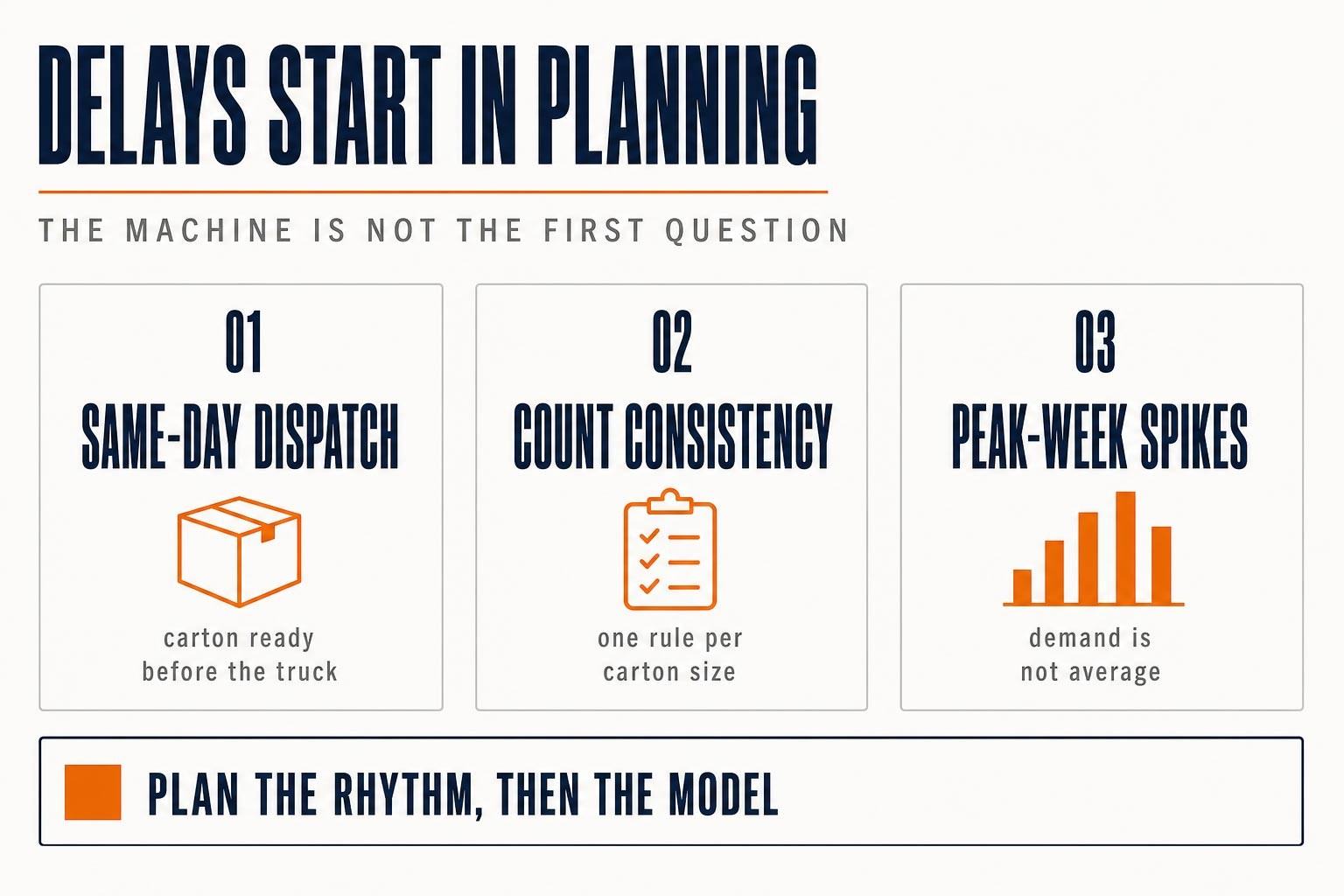
A paper cup boxing machine is often bought after order delays begin. But delays are usually a planning issue, not a machine issue. The machine decision should start with customer order rhythm: same-day dispatch windows, carton-count consistency requirements, and peak-week order spikes. If this rhythm is unclear, the same machine can feel right in demos and wrong in real runs.
Most profitable buyers do not pick packaging equipment first by model, they pick by process. They ask: How will this improve the time from good cup output to invoice-ready shipment? If the answer is not clear, the project should stay at manual or semi-manual stage until evidence improves.
This is especially true for operators transitioning from workshop-only dispatch to distributor-oriented batching. In that stage, the gap is not output capacity; it is predictable packaging rhythm.
What a paper cup boxing machine really does
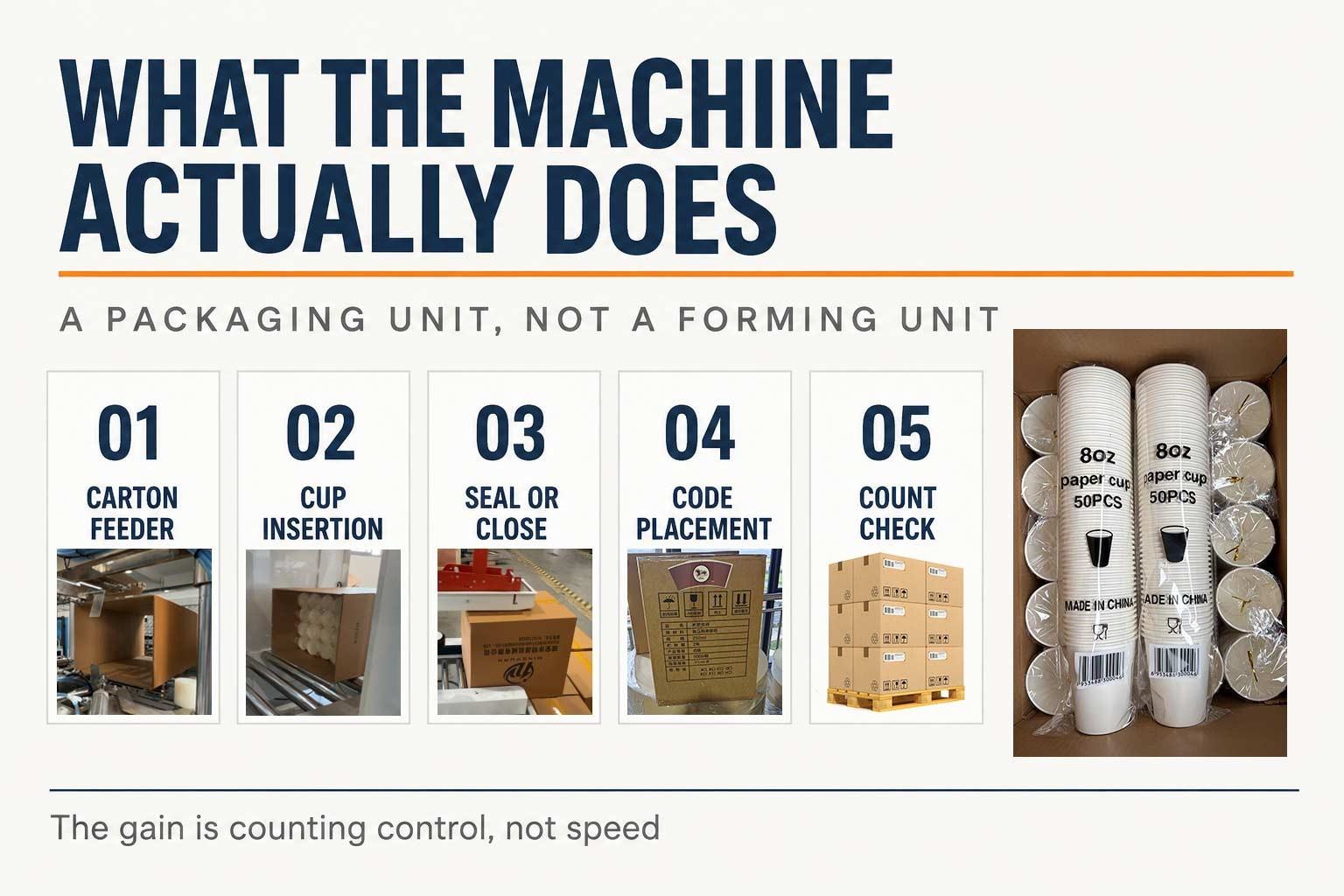
A common confusion is treating a paper cup boxing machine as a form of heavy forming equipment. It is not. It is a packaging orchestration unit. Its purpose is to convert grouped finished cups into transport-safe cartons according to size and count rules. It is also a control point where counting and labeling consistency are tested.
A basic capability set is usually:
- Carton feeder and position control
- Cup insertion and layer control
- Seal or close logic for packaging integrity
- Code placement or compatibility for downstream labeling workflows
- Batch-count check support (manual or automatic depending on model)
A clear rule helps the team: boxing should reduce downstream counting errors and shipping variability, not only reduce manual labor.
When linked to a stable paper cup production line, boxing can raise utilization of the whole line because teams stop spending the same person-hours on ad hoc packaging adjustments every shift.
How boxing links with the paper cup production line
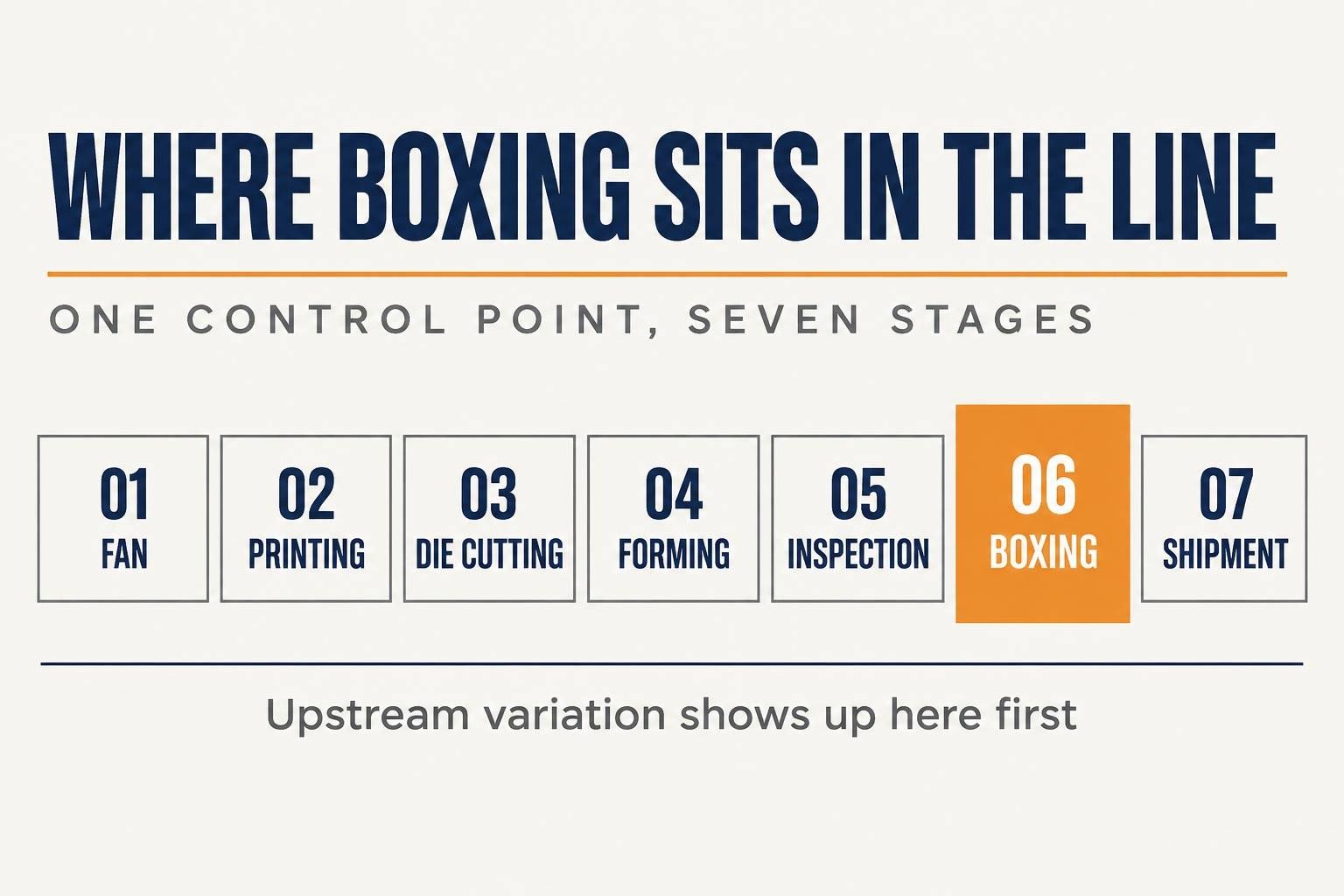
In small lines, buyers often improve one station and ignore the system effect. But boxing should be tested against the complete workflow:
paper cup fan -> printing -> die cutting -> forming -> inspection/counting -> paper cup boxing machine -> shipment.
If upstream stages are unstable, boxing performance will be unstable even if box speed appears high. If carton standards are unstable, formed cup quality gains may not convert into better dispatch.
| Stage | Risk if unmanaged | How boxing affects it |
|---|
| Formation output variability | Frequent carton adjustments | Reveals repeatability gaps sooner through cycle stops |
| Manual counting | Shipping disputes and mixed order counts | Makes counting standards easier to embed |
| Batch release | Late dock-ready deliveries | Improves dispatch predictability if carton standard exists |
Decision rules for choosing packaging automation
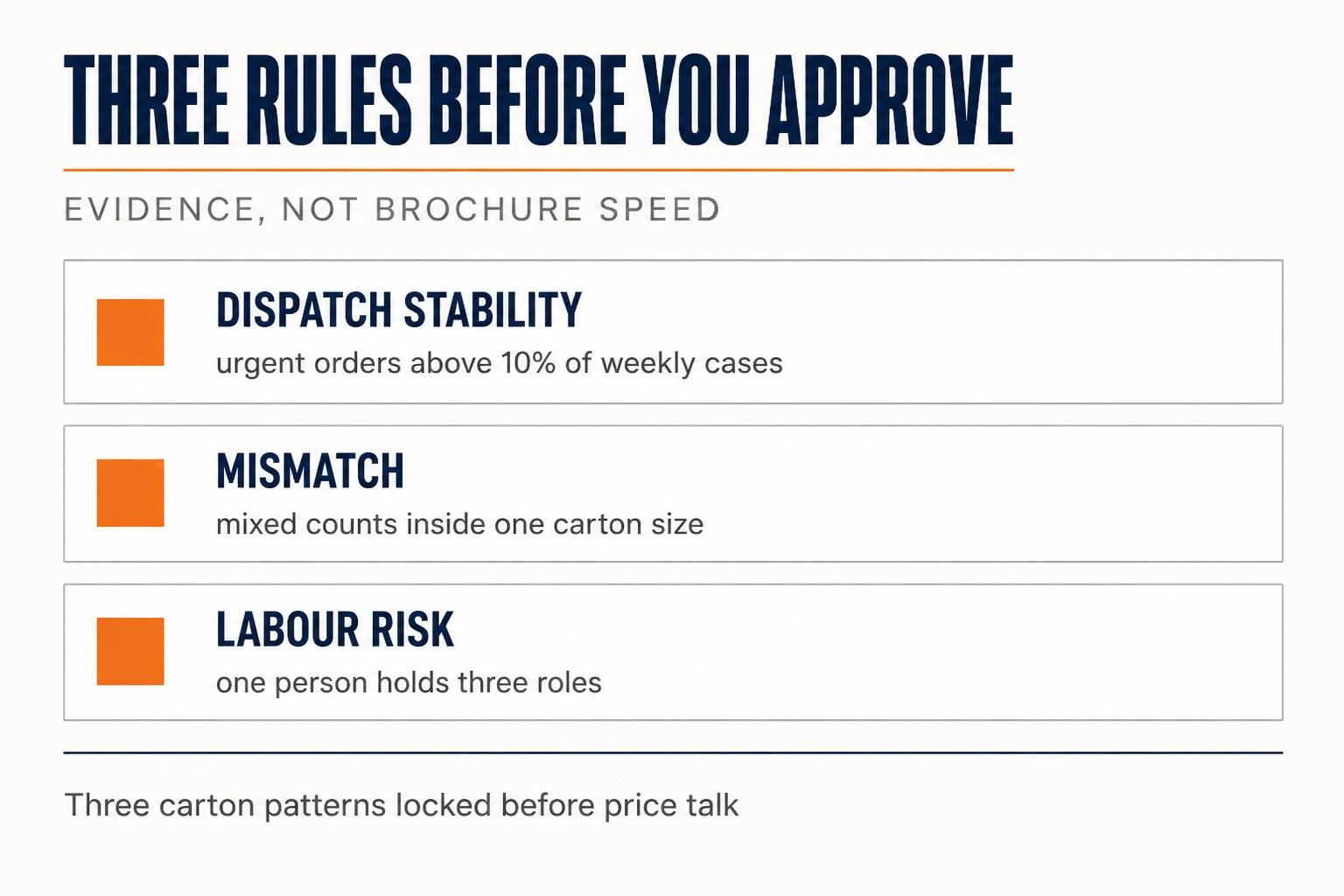
Use these three rules before approving any purchase:
- Dispatch stability rule: If urgent orders exceed 10% of weekly cases and same-day dispatch is required, review boxing options even if manual labor is still available.
- Mismatch rule: If same-size cup counts are mixed during packing, under-boxing becomes bottleneck quickly and leads to dispatch defects.
- Labor risk rule: If one person performs forming handoff, manual carton setup, and shipping checks, automation can be justified earlier to control errors.
This also means a paper cup packaging machine setup should be compared against expected carton mix and not against maximum theoretical output. For stable operations, a smaller but better matched machine often beats a larger multi-head setup.
A practical buyer checklist is: first define your top three carton patterns, then ensure supplier can lock cycle behavior on all three patterns before talking final price.
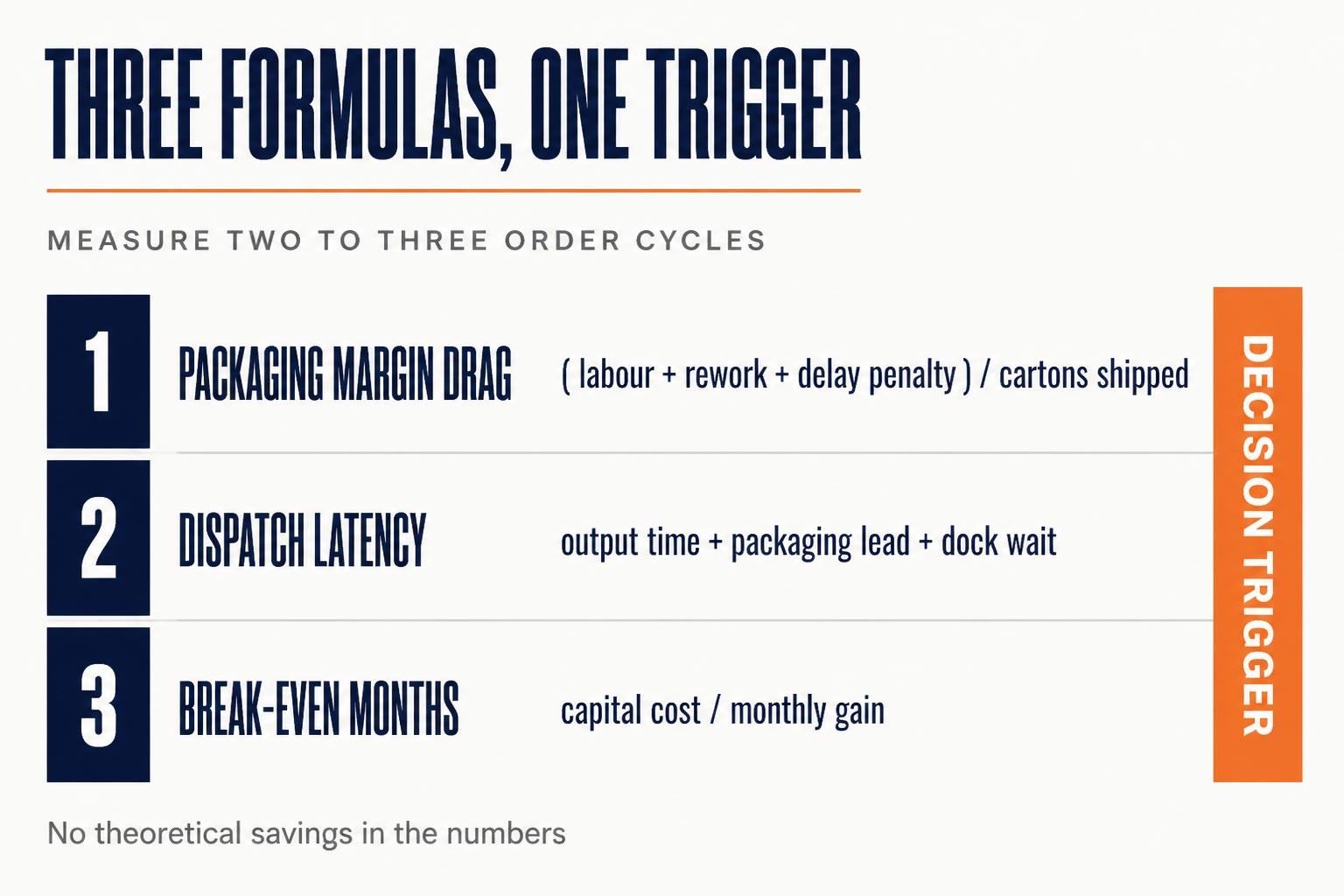
Use these formulas before committing to capacity:
1) Packaging margin drag
Packaging Margin Drag = (Manual labor cost + carton rework cost + delay penalty) / total cartons shipped
If this value is unstable, boxing may improve total margin more than increasing forming speed.
2) Order-to-dispatch latency
Dispatch Latency = Time completed output reaches good quality + packaging lead time + dock waiting time
The objective is to keep latency within your sales promise. If not, buyers usually face complaint rate growth before margin decline becomes visible.
3) Break-even trigger for adding boxing
Break-Even Months = Capital cost / (Monthly dispatch delay loss reduction + labor recovery gain + reduce-reject savings)
Do not include theoretical savings. Use realistic, measured data from at least 2 to 3 order cycles.
Model selection by buyer type and order pattern
| Buyer type | Recommended setup | Why |
|---|
| Startup factory, low mix | Semi-automatic paper cup boxing + standardized carton SOP | Lower cash lock-in, still removes manual inconsistency. |
| Local beverage distributor | Integrated paper cup wrapping machine + box coding | Different campaign lots and batch windows need high repeatability. |
| Factory serving multiple SKUs | Flexible cartonization with quick size change | Avoids reconfiguration downtime and missed dispatch windows. |
For every model, define carton standard first and then verify if the team can run it in three shifts. If not, scale may be too advanced for current labor quality.
Integration sequence and operating rules
The integration mistake is purchasing before sequence discipline. Start with this order:
- Stabilize upstream consistency: fan, printing, and die cutting variation should already be controlled.
- Standardize counting rules: choose one carton count per model.
- Standardize carton dimensions: avoid mixed cartons inside one campaign.
- Introduce boxing: begin with one product line and one shift.
- Evaluate dispatch variance: only then extend to full line or second shift.
A practical operational anchor: if your packaging area starts using a paper cup packaging machine-style workflow for setup documentation and defect coding, boxing changeover time drops faster and your team can scale with less retraining.
ROI scenario and upgrade rhythm
Many teams try to time upgrades with tax season or annual renewal. Better timing comes from order cycle behavior. A simple 2-stage rhythm is often better:
| Stage | Focus | Pass/Fail gate |
|---|
| Pilot (4-6 weeks) | One SKU, one carton pattern | At least 95% carton count accuracy and stable cycle time |
| Scale (next 8 weeks) | Multiple SKUs and two-shift operation test | Reduced dispatch delays and lower manual rework trend |
| Optimization (Quarterly) | Line balance with packaging and shipping | Profit per dispatched carton improves, complaints stabilize |
Warning: skip full capacity deployment if pilot still shows high setup time or unstable counting. That usually signals SOP gaps, not machine underpower.
Common mistakes that destroy boxing ROI
For many buyers, these are the six root causes of disappointing returns:
- Buying too many carton sizes too early. Variety adds complexity before output grows.
- Ignoring carton cost in material planning. Box upgrade without carton standard often creates mixed unit economics.
- No one-hour changeover SOP. Every SKU switch becomes a full-day learning issue.
- Using dispatch delay as a generic complaint metric. Track by order size and destination lane.
- Underestimating counting logic. A low-cost model with weak count control becomes expensive quickly.
- Overfitting to model brochure speed. Real utilization is what pays for investment, not max speed.
Critical reminder: a faster machine can still reduce profitability if packing discipline and order visibility are missing.
Capacity planning cross-check for mixed product streams
Mixing paper cups and paper tea cups, sleeves, and branded promotional cartons can create a false signal for equipment size. Operators read demand from peak days, but the machine actually works on count and carton type consistency. A practical guardrail is to model each carton family separately in a weekly mix, then compare total packaging minutes to available man-hours before adding automation. This avoids buying a machine for apparent capacity and then discovering it cannot handle the actual mix without overtime.
- Step 1: list top 5 carton families and their weekly volume and standard counts.
- Step 2: compute average changeover time per family and total counted carton checks per shift.
- Step 3: estimate dispatch-ready output per hour at pilot pace and verify against booked order slots.
If this exercise shows dispatch-ready output already below booked demand, boxing capacity is no longer a side topic. It becomes the central part of your commercial model, and the machine decision should be synchronized with product mix and customer SLA commitments.
Implementation timeline with checkpoints
A practical 60-day plan for teams that want to avoid rushed deployment:
- Days 1-15: lock 3 most frequent order types and one carton pattern. Record dispatch baseline without investment.
- Days 16-30: install selected model on one line, run pilot with 100% counting checks.
- Days 31-45: calculate dispatch latency and margin drag per carton type.
- Days 46-60: compare pilot result against gate rules; decide scale or delay.
This timeline is intentionally conservative for startups and local distributors. It prevents capital from being absorbed by an unverified workflow.
FAQ
Q1: Is a paper cup boxing machine required for small batches?
Not always. If batches are stable and dispatch windows are flexible, manual cartonization can remain cost-efficient.
Q2: Should I buy boxing before improving inspection?
No. Improve inspection and counting logic first. Boxing helps when upstream and midline are repeatable.
Q3: Which model depth do startups usually need?
Most start with semi-automatic packaging logic plus standardized SOP, then scale if dispatch data justifies it.
Q4: Can boxing solve late customer delivery complaints?
It reduces one part of delay but not all. Product lead-time depends on order planning and packing consistency together.
Q5: Can I use one boxing setup for coffee cups and tea cups?
Yes, if both product families use compatible carton sizes and count logic. Otherwise setup variation rises significantly.
Q6: What is the first indicator after installation?
Dispatch latency for your top three order types. Track it daily for at least two weeks.
The Bottom Line
A paper cup boxing machine should be introduced when the bottleneck moves from output creation to order dispatch consistency. If your goal is better profit and faster repeatable delivery, use decision formulas and staged rollout instead of immediate full-scale automation.
For most operations, the practical rule is simple: pilot one carton model, lock the workflow, confirm dispatch latency improvement, then expand. This protects cash flow and keeps technical risk visible.
If you are evaluating this decision now, start with your order list, not machine brochure. The best upgrade is the one that reduces dispatch delay and counting error on the same budget.





 Tel: +86-13362708280
 Email: george@paper-cupmakingmachine.com
 MP/WhatsApp: +86-13362708280
 Manufacturer Address:No.1588, Huaming Road, Feiyun Street,Ruian City Zhejiang Province -325200 China